
Precision in Action: How Ultrasonic Bone Scalpels Are Transforming Modern Surgery
For decades, bone-cutting procedures relied almost exclusively on high-speed pneumatic drills, rotational burrs, and manual rongeurs. While effective, these traditional mechanical instruments carry inherent risks. High-speed rotation generates significant thermal friction, creates bone dust, and requires substantial force—factors that increase the risk of accidental soft-tissue damage, nerve laceration, and heavy intraoperative bleeding.
Enter the Ultrasonic Bone Scalpel (UBS): an innovation in surgical technology that has elevated precision, minimized complications, and fundamentally reshaped complex procedures in neurosurgery, orthopedics, maxillofacial, and spine surgery.
What Is an Ultrasonic Bone Scalpel?
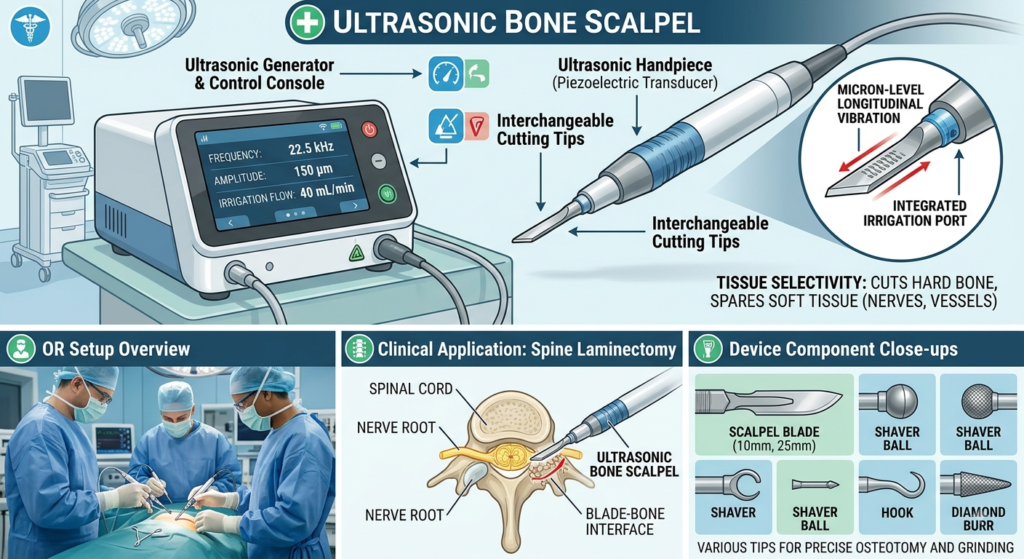
An ultrasonic bone scalpel is an advanced electro-surgical instrument designed to selectively cut hard osseous tissue while sparing surrounding soft tissue structures, such as nerves, dura mater, and blood vessels.
Unlike traditional rotary burrs or mechanical saws that shear bone through high-velocity rotation, the UBS utilizes high-frequency piezoelectric vibrations
The Core Technology: How It Works
The underlying mechanism of an ultrasonic bone scalpel relies on three main principles: piezoelectric vibration, selective tissue cutting, and acoustic cavitation
1. Piezoelectric Oscillation
The surgical console delivers electrical signals to a handpiece fitted with piezoelectric ceramics. These ceramics expand and contract, converting electrical energy into longitudinal mechanical micro-vibrations—typically oscillating at 22,500 to 36,000 Hz (cycles per second) with a microscopic stroke amplitude.
2. Selective Tissue Cutting
Because bone is rigid and non-compliant, it cannot absorb high-frequency micro-impacts. When the vibrating blade contacts hard, crystalline bone structure, it rapidly fragments and pulverizes the mineralized matrix.
Conversely, soft tissues (such as nerves, dura, muscles, and blood vessels) are elastic and compliant. When soft tissue touches the oscillating blade, it absorbs the energy and moves with the vibration rather than resisting it, leaving vital structures intact.
3. Integrated Irrigation & Cavitation
To prevent heat buildup, the scalpel continuously sprays a sterile saline solution through or along the blade. The ultrasonic energy creates a cavitation effect—microscopic vapor bubbles that form and collapse rapidly within the liquid. This cavitation destabilizes tissue fluids, flushes away bone debris, and promotes micro-hemostasis (coagulation of small blood vessels).
Traditional Rotary Drills vs. Ultrasonic Bone Scalpels
| Feature | Traditional High-Speed Rotary Drills | Ultrasonic Bone Scalpels (UBS) |
| Primary Motion | High-speed rotation (up to 75,000 RPM) | Micro-longitudinal oscillation (~22.5–36 kHz) |
| Soft Tissue Protection | High risk of wrapping, tearing, or thermal damage | Selective cutting; compliant soft tissue is preserved |
| Intraoperative Bleeding | High; causes micro-fractures and open marrow bleeding | Reduced; cavitation aids in micro-hemostasis |
| Cut Precision | Wide kerf; can create bone debris and dust | Hairline precision cuts with solid, intact bone blocks |
| Thermal Necrosis Risk | High without extensive continuous irrigation | Low due to integrated micro-saline mist and cavitation |
Primary Surgical Applications
1. Spine Surgery
Spine surgery demands extreme caution given the immediate proximity of the spinal cord and spinal nerve roots.
Laminectomy & Laminoplasty: Surgeons can make straight, precise osteotomies to remove vertebral arches without risking dural tears or nerve injury.
Deformity Correction (Scoliosis): Allows complex pedicle subtraction osteotomies and en-bloc resections with significantly less blood loss.
2. Neurosurgery & Craniotomy
In cranial procedures, removing skull bones near dural sinuses, brain parenchyma, or cranial nerves is delicate work. Ultrasonic devices allow neurosurgeons to thin or excise bone flaps while protecting the underlying brain tissue and brain membranes
3. Maxillofacial & Dental Surgery (Piezosurgery)
Used widely in orthognathic surgery, sinus lifts, and bone grafting. The fine control prevents damage to sensitive structures like the inferior alveolar nerve and Schneiderian membrane.
4. Orthopedics & Joint Reconstruction
Facilitates delicate bone cuts in hand, foot, and joint replacement procedures where maintaining structural integrity and conserving native bone grafts is vita
Key Clinical Benefits
“The ability to cut hard bone adjacent to delicate neurological structures without mechanical grabbing or tearing represents one of the most significant advances in spine and neurosurgical safety.”
Enhanced Safety & Reduced Complication Rates: The risk of incidental durotomy (dural tears) and nerve root injury drops significantly compared to standard high-speed drills.
Minimization of Blood Loss: Ultrasonic cavitation cauterizes micro-vessels within the cancellous bone, maintaining a cleaner, clearer surgical field.
Harvestable Autologous Bone: Unlike drills that turn bone into fine dust, the UBS cuts clean slices or blocks. Surgeons can reuse this native bone as an autograft for fusions, reducing reliance on costly synthetic bone substitutes.
Reduced Operative Time & Fatigue: Clean, single-pass osteotomies often cut overall surgical time down, lowering anesthesia exposure for the patient and ergonomic fatigue for the surgical team.
Considerations and Limitations
While ultrasonic bone devices offer clear benefits, they are not without trade-offs:
Learning Curve: Surgeons accustomed to tactile feedback from rotary drills must adapt to the light, sweeping motion required for ultrasonic instruments.
Capital Cost: Ultrasonic generators and specialized single-use or limited-reuse tip handpieces carry higher initial equipment costs than conventional pneumatic drills.
Thick Cortical Bone Density: In extremely dense, thick cortical bone, bone scalpels can take slightly longer per cut than aggressive burrs, requiring patience and steady fluid irrigation.
The Future of Ultrasonic Bone Surgery
As minimally invasive surgery (MIS) continues to advance, ultrasonic bone scalpels are evolving alongside it. Current innovations focus on smaller-profile micro-blades designed specifically for endoscopic and tubular access spine surgeries. Future integrations with robotics and image-guided navigation platforms will further refine precision, allowing algorithms to dictate cut depth and boundaries automatically.
Ultrasonic bone scalpels represent a fundamental shift in surgical philosophy: moving away from blunt mechanical force toward frequency-controlled, tissue-specific execution. For both surgeons and patients, this technology translates to safer procedures, lower complication rates, and faster recoveries.