
The human spine is a masterpiece of biological engineering, balancing rigid structural support with fluid movement. At the center of this flexibility are twenty-four intervertebral discs—specialized fibrocartilaginous pads that act as shock absorbers, load distributors, and mechanical pivots.
While we often focus on muscle strength or posture when discussing back health, the microscopic driver of spinal longevity is far simpler: water. The interaction between spinal hydration and intervertebral disc elasticity dictates whether your spine absorbs daily impacts effortlessly or degrades under routine physical stress.
The Architecture of a Spinal Disc
To understand why hydration governs disc function, it helps to examine how an intervertebral disc is built. Each disc consists of three primary components:
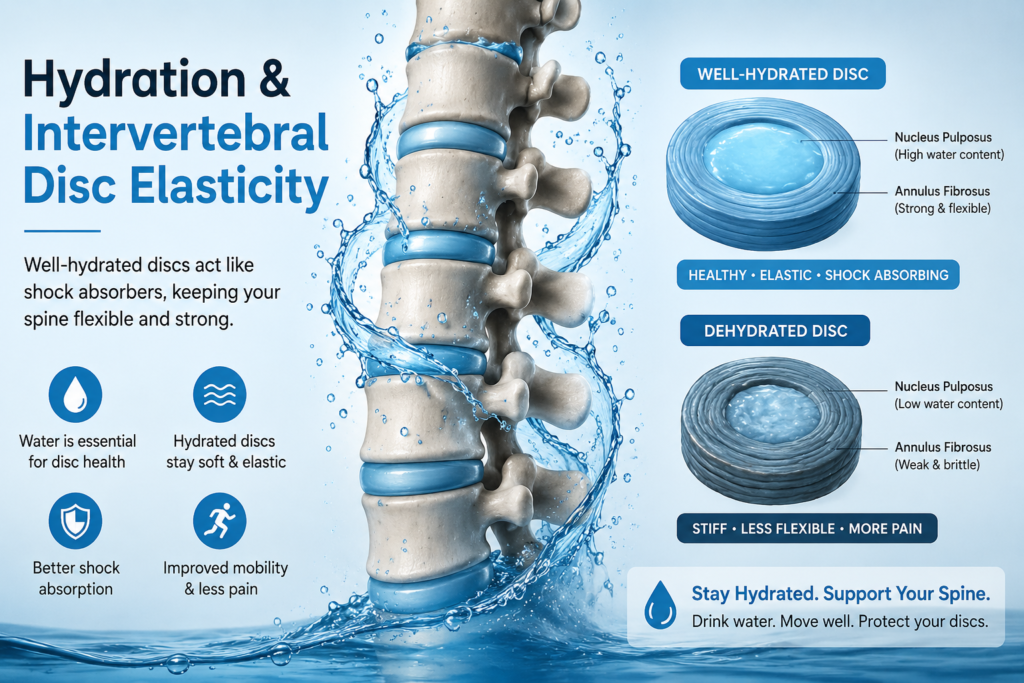
The Nucleus Pulposus (NP): The jelly-like central core. In a healthy young adult, the nucleus pulposus is roughly 80% to 85% water. It contains a dense network of proteoglycan molecules—specifically aggrecan—which act like microscopic sponges, attracting and holding water through negative electrical charges.
The Annulus Fibrosus (AF): A tough, multi-layered ring of concentric collagen fibers that encapsulates the nucleus pulposus. The outer annulus resists tensile forces during bending, twisting, and axial compression.
Cartilaginous Endplates: Thin layers of cartilage that anchor the disc to the adjacent vertebral bodies above and below, serving as the main pathway for nutrient exchange.
How Water Drives Elasticity and Shock Absorption
Elasticity in mechanical systems refers to a material’s ability to deform under load and return to its original shape when the load is removed. In the spine, this biomechanical elasticity is almost entirely water-dependent.
Water itself is incompressible. When you stand, run, or jump, axial load compresses the spine, pushing down on the gelatinous nucleus pulposus. Because the water within the nucleus cannot compress, it exerts hydrostatic pressure outwards in all directions. This outward expansion presses against the surrounding ring of the annulus fibrosus, which stretches to absorb the energy.
This mechanism transforms compressive vertical energy into lateral wall tension. When the physical load is released, the elastic collagen fibers of the annulus spring back, pushing the nucleus back into its resting state. Without adequate hydration within the nucleus pulposus, this hydro-mechanical shock absorber fails, forcing the solid bone structures of the spine to take direct impact.
The Daily Hydration Cycle (Diurnal Imbibition)
Your spine actually changes height between the time you wake up and the time you go to sleep. This daily fluctuation is governed by a process known as diurnal fluid exchange:
Daytime Exudation (Fluid Loss): Throughout the day, gravity and physical activity exert continuous pressure on your discs. Hydrostatic pressure inside the nucleus exceeds the osmotic swelling pressure, forcing fluid and metabolic waste out through the cartilage endplates into surrounding blood vessels. As a result, you can lose up to 1.5 to 2 centimeters of total height by the end of the day, alongside a temporary drop in disc elasticity.
Nighttime Imbibition (Fluid Reabsorption): When you lie flat in bed, axial load drops to nearly zero. The high concentration of negatively charged proteoglycans inside the nucleus creates a strong osmotic gradient. Water flows back into the disc through fluid imbibition, restoring disc height, re-pressurizing the nucleus, and resetting its elastic properties for the coming day.
Dehydration and the Cascade of Disc Degeneration
As we age—or when chronic systemic dehydration and poor movement habits set in—the biochemical composition of the disc changes. The synthesis of aggrecan and proteoglycans declines, reducing the disc’s ability to hold onto water.
When disc hydration falls below optimal levels, a predictable biomechanical cascade occurs:
Loss of Turgor Pressure: The nucleus loses its plump, gel-like hydrostatic core and becomes fibrous, dry, and brittle.
Uneven Load Distribution: Without hydrostatic pressure pushing evenly outward, compressive loads transfer directly to the annulus fibrosus and the vertebral endplates.
Micro-Tearing and Delamination: The annulus fibrosus is designed to resist outward expansion, not direct vertical crushing. Over time, vertical pressure causes radial and concentric tears in the annular rings.
Height Loss and Spinal Instability: As disc height permanently decreases, surrounding ligaments become slack, leading to abnormal facet joint wear, nerve root impingement (sciatica), and localized inflammation.
Actionable Strategies to Maintain Disc Hydration
Because intervertebral discs lose their direct blood supply in early adulthood, they rely on mechanical movement and systemic fluid availability for nutrient delivery and hydration. Here is how you can support your disc health daily:
1. Drink Water Consistently
Systemic hydration provides the raw fluid needed for nighttime fluid imbibition. Aim for steady water intake throughout the day rather than chinking large volumes all at once.
2. Move to Drive the ‘Spinal Pump’
Discs act like mechanical sponges. Alternating between gentle compression and decompression creates a pumping action that drives nutrient-rich fluid in and waste products out. Walking, gentle spinal extension, swimming, and light mobility work encourage fluid exchange far better than prolonged stationary sitting.
3. Optimize Sleeping Posture and Duration
Uninterrupted sleep (7 to 8 hours) in a horizontal position gives your discs the necessary time without gravity to reabsorb fluid. Ensure your mattress maintains neutral spinal alignment to prevent continuous uneven compression on specific discs overnight.
4. Take Micro-Breaks From Prolonged Sitting
Sitting creates significantly higher intradiscal pressure than standing or lying down. Standing up every 30 to 45 minutes reduces sustained hydrostatic squeeze, giving your discs a brief break from continuous exudation.
Summary Table: Hydrated vs. Dehydrated Discs
| Metric / Trait | Hydrated Disc | Dehydrated / Degenerated Disc |
| Nucleus Water Content | ~80% – 85% | Less than 65% – 70% |
| Primary Mechanical Role | Efficient fluid shock absorption | Bone-on-bone compression & structural wear |
| Load Distribution | Hydrostatic, equal 360° dispersion | Concentrated, uneven pressure on outer rings |
| Risk of Tears / Herniation | Low structural risk | High risk of annular tears & disc bulging |
| Diurnal Recovery | Re-plumps fully overnight | Poor fluid imbibition and loss of height |
Keeping your spinal discs well-hydrated is one of the most effective ways to preserve mobility, prevent back pain, and maintain spinal resilience as you age.