
When heavy loads are combined with poor lifting mechanics, the lumbar spine absorbs massive compressive and shearing forces that far exceed its structural threshold. Rounding the lower back while lifting shifts the burden away from the legs and glutes—the body’s largest muscle groups—and transfers high biomechanical stress onto the intervertebral discs and spinal ligaments. Over time, this repetitive mechanical stress degrades the outer disc fibers (annulus fibrosus), paving the way for disc herniation, spinal stenosis, and chronic lower back pain.
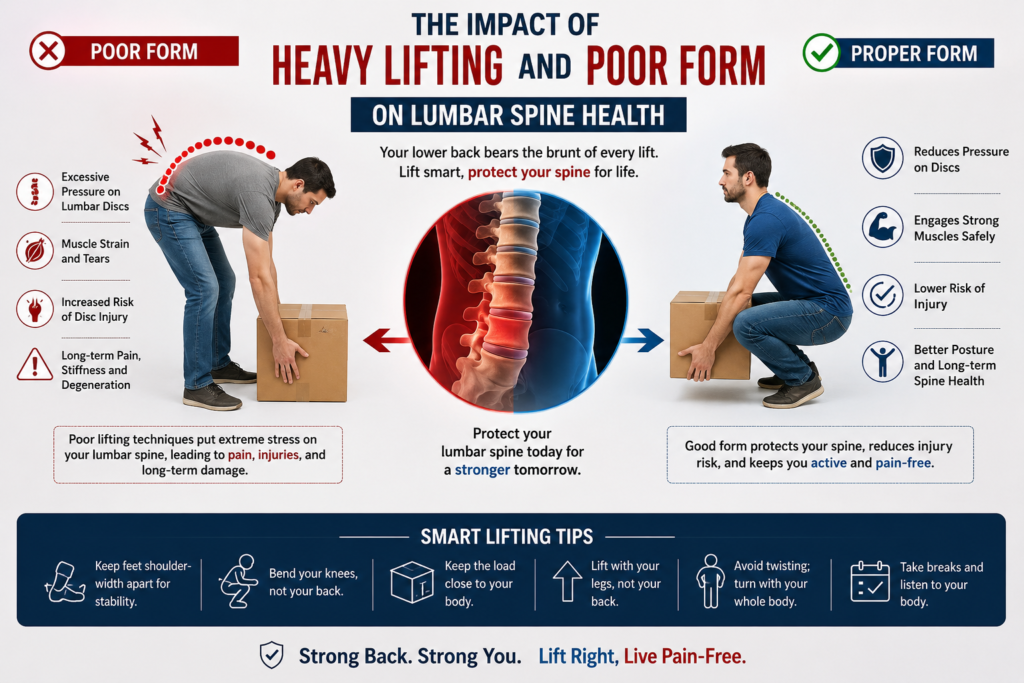
Key Anatomical Risks of Compromised Lifting Form
Uneven Disc Compression: Bending at the waist pushes the jelly-like center (nucleus pulposus) backward against nerve roots.
Ligamentous Sprain: Forcing the lumbar spine into extreme flexion places excessive tension on static stabilizing ligaments.
Paraspinal Muscle Spasms: Overworked erector spinae muscles tighten rapidly to protect the spine, resulting in acute, debilitating stiffness.
Accelerated Wear and Tear: Repeated micro-trauma speeds up degenerative disc disease, narrowing the spinal canal over time.
Protecting your lumbar spine requires maintaining a neutral spine posture, hinging cleanly at the hips, and engaging core stabilizers before initiating any heavy lift.
Biomechanical & Anatomical Consequences
Uneven Disc Pressure: Bending forward while lifting unevenly compresses the anterior portion of the intervertebral disc, driving the inner fluid (nucleus pulposus) backward toward the spinal cord.
Annular Tear Risk: High shearing forces during flexed lifting stretch and tear the concentric outer layers (annulus fibrosus) of spinal discs.
Lumbar Hyper-Flexion: Rounding the lower back flattens its natural inward curve (lordosis), transferring load away from muscles and placing it directly onto passive spinal structures.
Endplate Fracture Risk: Severe axial loading with compromised alignment can fracture the cartilaginous vertebral endplates, cutting off vital nutrient supply to the disc.
Loss of Intra-Abdominal Pressure: Lifting without proper core brace eliminates the protective internal air-cushion effect that stabilizes the lumbar spine.
Increased Shearing Strain: Hinging from the waist rather than the hips generates excessive force parallel to the vertebrae, trying to slide one lumbar bone off another.
Facet Joint Overload: Hyper-extending at the top of a heavy lift pinches the posterior facet joints together, causing painful cartilage wear and inflammation.
Acute Injuries & Structural Damage
Acute Disc Herniation: A single heavy rep with a rounded spine can force inner disc tissue to rupture through the outer wall, pressing directly on spinal nerves.
Severe Sciataca: Nerve root compression caused by a bulging disc triggers burning pain, numbness, and tingling down the buttocks and legs.
Acute Lumbar Strain: Forcing the spinal erector muscles to lift weights meant for the legs causes acute muscle fiber tears and intense spasms.
Ligamentous Sprain: Over-stretching passive stabilizers like the posterior longitudinal ligament weakens long-term joint stability.
Vertebral Compression Fractures: In individuals with compromised bone density, high impact or poor form during heavy lifts can collapse vertebral bodies.
Paraspinal Guarding: The body responds to acute tissue damage by locking up surrounding lumbar muscles in painful, continuous contraction.
Chronic & Long-Term Health Impacts
Accelerated Degenerative Disc Disease: Repeated micro-trauma from poor lifting mechanics dehydrates discs and reduces overall spine height prematurely.
Spinal Stenosis Development: Chronic inflammation and bone spurs from poor mechanics narrow the spinal canal, encroaching on nerves.
Spondylolisthesis Risk: Persistent shearing forces can crack the vertebral arch (spondylolysis), causing a vertebra to slip forward out of alignment.
Chronic Lower Back Pain (CLBP): Unresolved soft-tissue injuries and structural wear evolve into persistent nerve-sensitized back pain lasting years.
Permanent Loss of Mobility: Chronic scar tissue accumulation restricts normal spinal articulation and core range of motion.
Postural Adaptation: Chronic pain from improper lifting causes the pelvis to tilt, creating compensations in upper back and hip posture.
Muscle Imbalances & Kinetic Chain Issues
Glute Amnesia: Relying entirely on the lower back during heavy lifts disables proper recruitment of the gluteus maximus.
Hamstring Over-Dominance: Tight or overworked hamstrings pull on the ischial tuberosity, forcing the lumbar spine into forced flexion during deep lifts.
Compromised Core Function: Lifting purely with back muscles de-conditions the transverse abdominis, reducing default spine protection.
Hip Flexor Tightness: Compensating for weak posterior chain mechanics causes hip flexors to shorten, pulling the pelvis out of alignment.
Asymmetrical Mechanical Wear: Uneven weight distribution during asymmetric lifts causes unilateral wear on disc walls and spinal joints.
Heavy lifting acts as a double-edged sword for the lumbar spine: executed with proper form, it strengthens surrounding musculature and reinforces bone density, but when paired with compromised mechanics, it subjects intervertebral discs and facet joints to unsafe shear and compressive forces. Flexing, rounding, or twisting under heavy loads shifts mechanical stress away from active muscle groups and onto passive spinal structures, drastically heightening the risk of acute disc herniations, ligamentous sprains, and accelerated long-term degenerative wear.
Ultimately, maintaining lumbar spine health does not require avoiding resistance training, but rather respecting human biomechanics. Prioritizing neutral spine alignment, deep core stabilization, and gradual progressive overload transforms heavy lifting from a structural hazard into a powerful tool for long-term spinal durability.