
We’ve all been there—a looming deadline at work, a family argument, or the general weight of a chaotic week. You feel the tension in your shoulders, your jaw clenches, and then, like an unwelcome guest, that familiar, searing pain shoots down your leg.
If you live with sciatica, you might have noticed a frustrating pattern: your back and leg pain seem to get worse exactly when your life gets harder. It feels like a cruel joke from the universe, but it’s actually a well-documented physiological phenomenon.
The link between psychological stress and physical nerve pain isn’t just “all in your head.” It is a complex interaction between your brain, your hormones, and your nervous system. In this deep dive, we’ll explore why your nerves flare up when you’re overwhelmed and how you can break the cycle.
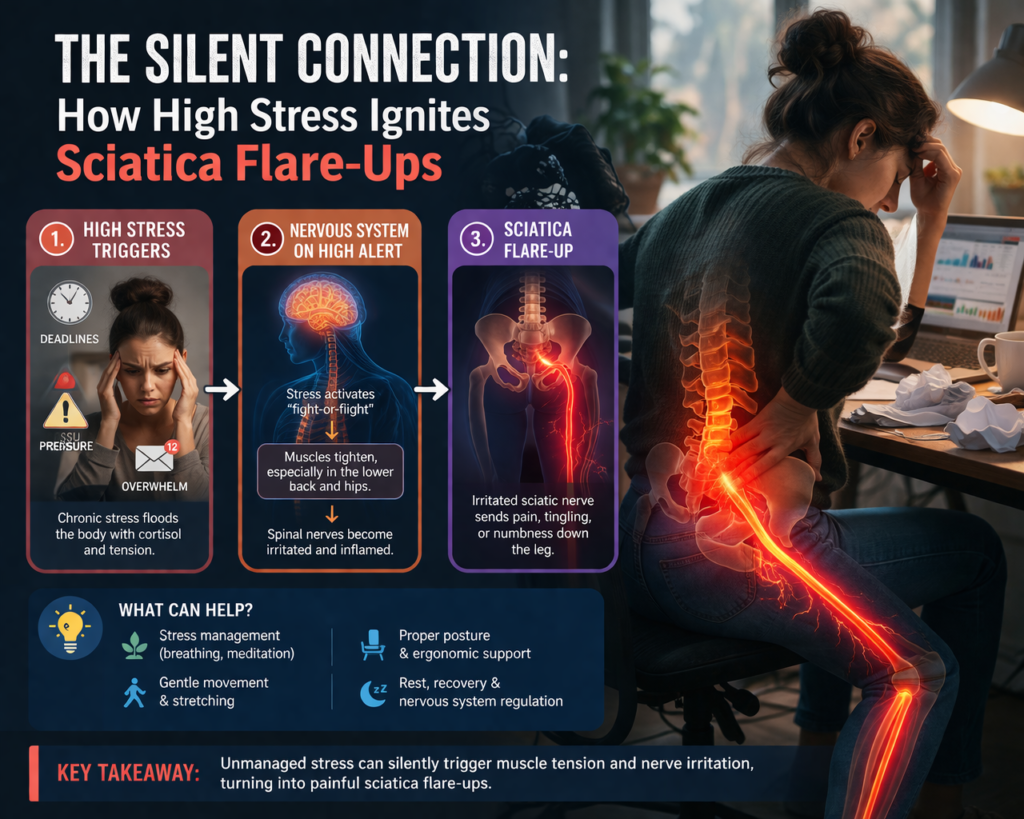
Understanding the Sciatic Nerve: The Body’s Longest Messenger
To understand why stress hurts, we first have to look at what the sciatic nerve actually is. It is the largest and longest nerve in the human body, beginning in your lower back (lumbar spine), running through your hips and buttocks, and branching down each leg.
When this nerve is compressed or irritated—often by a herniated disc, bone spur, or muscle tension—it causes sciatica. This isn’t a disease in itself, but a symptom of an underlying issue. It manifests as:
Sharp, electric-shock-like pain.
Numbness or “pins and needles” in the foot.
Muscle weakness.
Burning sensations that worsen with sitting or standing.
The Biological "Triple Threat": How Stress Triggers Pain
When you are overwhelmed, your body enters “Fight or Flight” mode. While this was great for escaping predators thousands of years ago, the modern version—sitting at a desk stressing over emails—causes a physiological cascade that directly impacts your sciatic nerve.
1. The Cortisol Connection and Inflammation
When you’re stressed, your adrenal glands pump out cortisol. In short bursts, cortisol is anti-inflammatory. However, under chronic stress, your body becomes desensitized to it. This leads to a “pro-inflammatory” state.
Nerves are incredibly sensitive to their environment. If the tissues surrounding your sciatic nerve are bathed in inflammatory chemicals due to systemic stress, a minor irritation can turn into a full-blown flare-up.
2. The Muscle Guarding Reflex
Have you ever noticed how your posture changes when you’re anxious? Your shoulders hunch, and your pelvic muscles tighten. This is known as muscle guarding.
The piriformis muscle, located deep in the buttock, sits directly over (and sometimes wraps around) the sciatic nerve. When you are stressed, the piriformis tends to contract and tighten. This can lead to Piriformis Syndrome, where the muscle literally strangles the sciatic nerve, mimicking the pain of a herniated disc.
3. Oxygen Deprivation (The Sarno Theory)
The late Dr. John Sarno, a pioneer in mind-body medicine, proposed a theory called TMS (Tension Myoneural Syndrome). He argued that the brain subconsciously restricts blood flow to certain muscles and nerves during times of emotional repression or high stress. This slight reduction in oxygen (mild ischemia) can cause intense pain, tingling, and numbness—the hallmarks of sciatica.
The Feedback Loop: Pain Causes Stress, Stress Causes Pain
The most difficult part of managing sciatica is the “vicious cycle.”
Life Stress: You have a bad week.
Physical Tension: Your muscles tighten and inflammation rises.
The Flare-up: Your sciatic nerve begins to scream.
Secondary Stress: Now, you are stressed about the pain. You worry about missing work, your mobility, and whether you’ll ever feel “normal” again.
Amplification: This secondary stress keeps your nervous system in a state of high alert (central sensitization), making the pain feel even more intense than the physical injury warrants.
How to Calm Your Nervous System (and Your Sciatica)
If your sciatica is flared up due to stress, traditional physical therapy is important, but it might not be enough. You have to address the “software” (your nervous system) as well as the “hardware” (your spine).
1. Downregulate the Nervous System
You need to tell your brain that you are safe. Techniques like Diaphragmatic Breathing (Belly Breathing) stimulate the vagus nerve, which flips the switch from “Fight or Flight” to “Rest and Digest.”
2. Movement as Medicine (Not Punishment)
When in pain, we tend to stop moving. This is the worst thing for sciatica. Gentle movement, such as Neural Flossing or “nerve gliding,” helps the nerve slide through the soft tissue, reducing adhesions and improving blood flow without putting the body under more stress.
3. Mind-Body Mapping
Acknowledge the timing of your pain. Keeping a journal can help you see if your flare-ups correlate with specific stressors. Simply acknowledging, “My back hurts because I am feeling overwhelmed right now,” can actually reduce the brain’s “danger” signals and lower the pain volume.
4. Anti-Inflammatory Lifestyle
Since stress increases systemic inflammation, counter it with:
Magnesium-rich foods: To help muscles relax.
Hydration: Nerves need hydration to conduct signals properly.
Sleep Hygiene: High-quality sleep is the only time your nerves truly undergo repair.
When to See a Professional
While stress management is key, you should never ignore “Red Flag” symptoms. Please consult a doctor immediately if you experience:
Sudden loss of bladder or bowel control.
Severe weakness in your legs (stumbling or “foot drop”).
Pain that is so intense it prevents sleep entirely.