
Waking up should leave you feeling refreshed and ready to take on the day. But for millions of people, the morning routine starts with a familiar, frustrating ritual: rolling out of bed, gripping the lower back, and waiting for the stiffness to fade.
If your back hurts worse first thing in the morning than it does before you go to sleep, you aren’t imagining things. There are specific physiological reasons why sleep can sometimes trigger or worsen back pain.
1. Natural Overnight Inflammation (The "Gelling Effect")
When you are moving throughout the day, your joints are constantly lubricated by synovial fluid. However, when you lie still for seven to eight hours, that lubrication slows down.
If you have mild, underlying joint wear-and-tear or conditions like osteoarthritis, the fluid thickens during prolonged rest. This is known as the “gelling effect.” Without regular movement to pump fresh fluid through the joints, you wake up feeling incredibly stiff and achy.
2. Spinal Disc Engorgement
Your spinal discs act as shock absorbers between your vertebrae. During the day, gravity compresses your spine, causing these discs to lose small amounts of water.
When you lie down at night, the pressure is released, and the discs rehydrate by absorbing fluid from the surrounding tissue. By early morning, your discs are actually fully filled and at their maximum volume. This extra fluid makes the spine structurally tighter and less flexible for the first few minutes after you get out of bed, increasing pressure on nearby nerves and muscles.
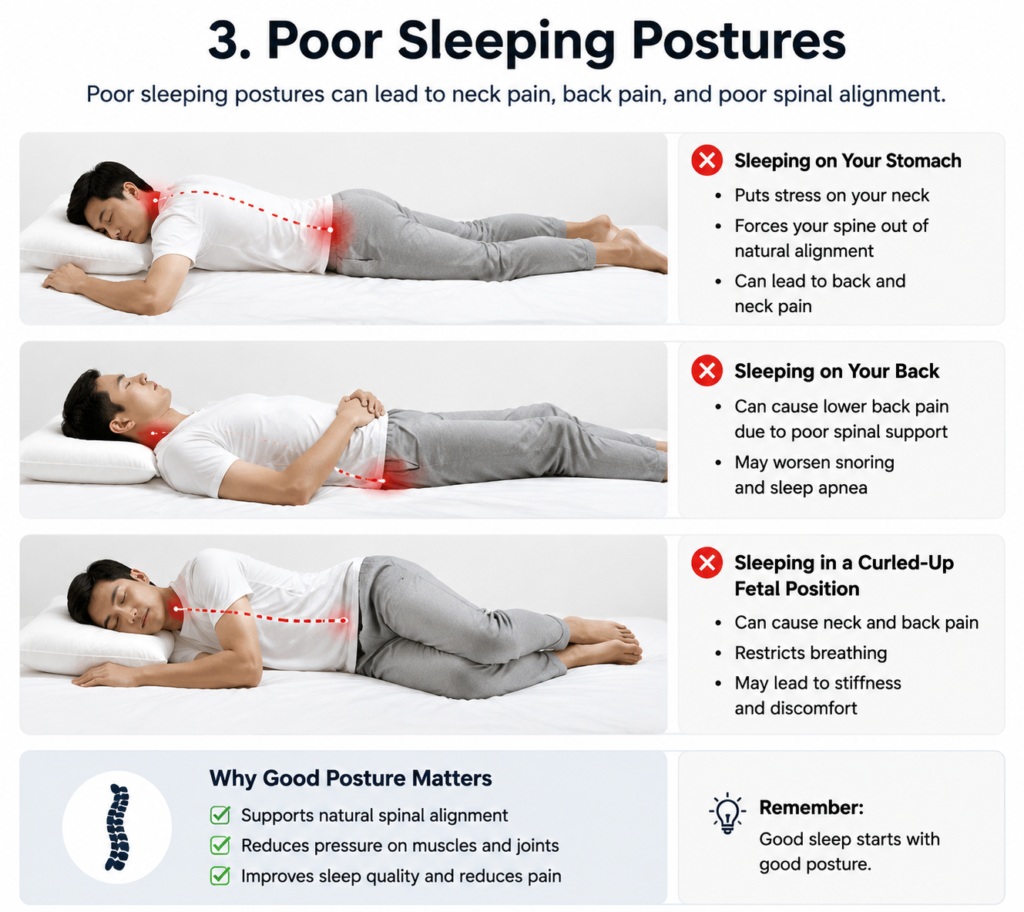
3. Poor Sleeping Postures
Your favorite sleeping position might be putting undue stress on your spine. The goal of a good sleeping posture is to maintain the natural curves of your neck, mid-back, and lower back.
Stomach Sleeping: This is generally the hardest position on your back. Sleeping on your stomach forces your neck to turn sharply to one side, which twists the spine. It also allows your pelvis to sink into the bed, flattening the natural curve of your lower back and stressing the lumbar facet joints.
-
Side Sleeping Without Support: If you sleep on your side and your top leg drops forward to rest on the mattress, it twists your pelvis and puts a rotating strain on your lower spine all night.
-
Back Sleeping Without Alignment: While back sleeping is great for weight distribution, sleeping perfectly flat can strain the lower back if your hamstrings or hip flexors are tight.
4. A Sagging or Overly Firm Mattress
A mattress that is too soft will sag under your heaviest areas (your hips and pelvis), causing your spine to hammocking out of alignment. Conversely, a mattress that is too firm won’t accommodate the natural contours of your shoulders and hips, creating painful pressure points.
The Golden Rule: Studies consistently show that a medium-firm mattress offers the best balance of support and pressure relief to reduce morning back pain.
Simple Fixes for Better Mornings
If you want to stop waking up in pain, small adjustments to your bedtime and morning routines can make a significant difference:
Use Support Pillows: If you sleep on your side, place a pillow between your knees to keep your hips level. If you sleep on your back, put a pillow under your knees to reduce pressure on your lumbar spine. If you must sleep on your stomach, slide a flat pillow under your pelvis to keep your spine neutral.
Don’t Roll Straight Up: Avoid the temptation to sit straight up like a pendulum when your alarm goes off. Instead, use the “log roll” technique: roll onto your side, use your arms to push your upper body up, and let your legs swing over the edge of the bed simultaneously.
Gentle Morning Stretches: Before bending over to put on your shoes, spend 2 to 3 minutes doing gentle movements like knee-to-chest hugs or standing pelvic tilts to get the fluid moving in your spine again.