
Staying active is one of the best ways to recover from a herniated disc, but picking the wrong workout can set you back weeks. When an intervertebral disc herniates, its gel-like center (nucleus pulposus) pushes outward through a tear in the tough outer ring (annulus fibrosus), often compressing nearby spinal nerves.
Understanding the Mechanics: What Makes a Movement Dangerous?
Your spinal discs act as shock absorbers. Certain movements multiply the mechanical load on these discs dramatically:
Spinal Flexion (Bending Forward): Flexing the spine squeezes the front of the vertebrae together, forcing the inner disc material backward—directly toward the spinal nerves.
Axial Loading (Vertical Weight on the Spine): Heavy weights placed directly on your shoulders or overhead compress the spinal column, squishing damaged discs under pressure.
Rotation Under Load (Twisting): Twisting the torso stretches the outer fiber rings of the disc, making tears worse—especially when combined with forward bending.
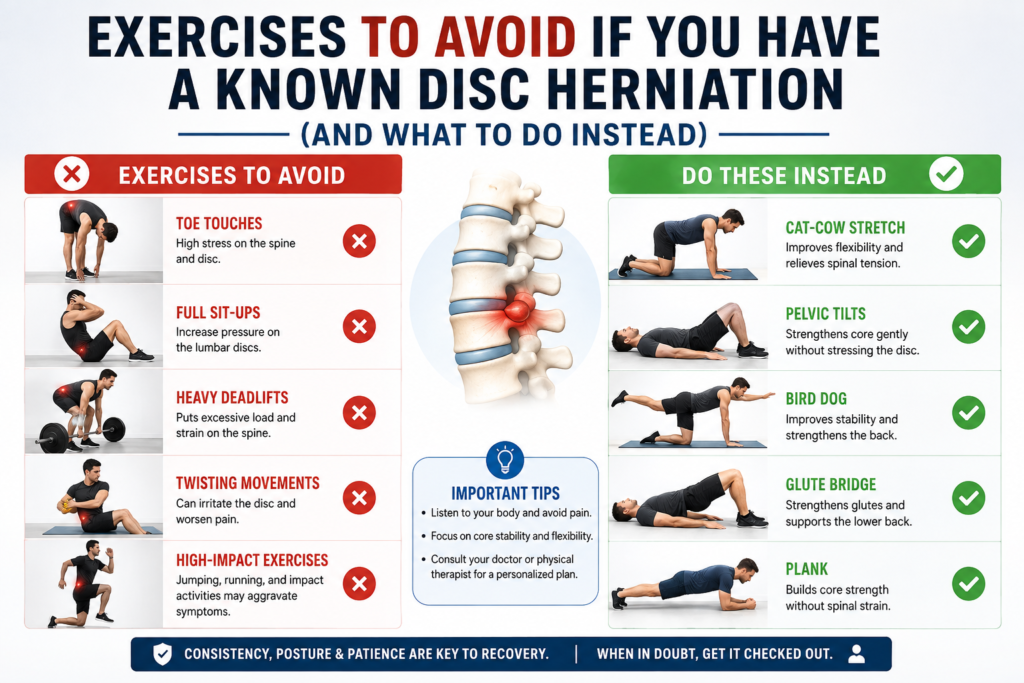
Main Exercise Categories to Avoid
1. High-Impact & Axial Loading Exercises
The Culprits: Heavy barbell squats, deadlifts, overhead shoulder presses, and running or jumping on hard surfaces.
Why They Harm: Loading a barbell onto your shoulders or deadlifting heavy weights puts immense vertical pressure on lumbar discs. High-impact cardio like running adds repeated jolts to an already vulnerable structure.
Safer Alternative: Bodyweight box squats (focusing on a neutral spine), goblet squats with light weight, chest-supported rows, and low-impact cardio like swimming or using an elliptical machine.
2. Deep Spinal Flexion (Forward Bending)
The Culprits: Standing or seated toe touches, traditional sit-ups, crunches, and bicycle crunches.
Why They Harm: Flexing your spine rounds the lower back, driving the disc herniation posteriorly (backward) into the spinal canal where root nerves reside.
Safer Alternative: Spine-neutral core exercises such as Bird-Dogs, Planks, and Pallof Presses that build core stability without bending your spine.
3. Weighted or Rapid Torso Twisting
The Culprits: Russian twists, seated torso rotation machines, and high-velocity golf or tennis swings without core engagement.
Why They Harm: Torsional (twisting) force weakens the outer fibers of the spinal disc. Combining rotation with slight forward flexion creates the exact mechanism that causes or worsens disc herniation.
Safer Alternative: Isometric anti-rotation drills like anti-rotation press-outs using resistance bands.
4. Aggressive Hamstring Stretches
The Culprits: Seated forward folds, standing hamstring stretches with a rounded back, or hurtler stretches.
Why They Harm: Tight hamstrings are common with back pain, but pulling hard on them often forces the lower back to round. Additionally, aggressive leg stretches can pull on irritated sciatic nerves, mimicking or intensifying disc pain.
Safer Alternative: Supine hamstring stretches using a strap around your foot while keeping your lower back flat on the floor and maintaining a natural lumbar curve.