
Biologic Bone Grafts & Growth Factors: The Future of Regenerative Medicine
The field of regenerative medicine has transformed dramatically over the last few decades, shifting from simple structural replacements to sophisticated, biologically active treatments. Among the most significant advancements are biologic bone grafts and growth factors, which harness the body’s natural healing mechanisms to repair and regenerate bone tissue. Whether utilized in complex orthopedic surgeries, spinal fusions, or advanced dental implantology, these innovations offer unprecedented healing potential.
1. The Evolution of Bone Grafting
Traditional bone grafting relied heavily on autografts (bone harvested from the patient’s own body, typically the iliac crest) or allografts (bone sourced from human donors). While effective, autografts present challenges such as donor-site morbidity, increased surgical time, and limited supply. Allografts, conversely, carry a minor risk of disease transmission and often lack the cellular vitality required for rapid osteogenesis.
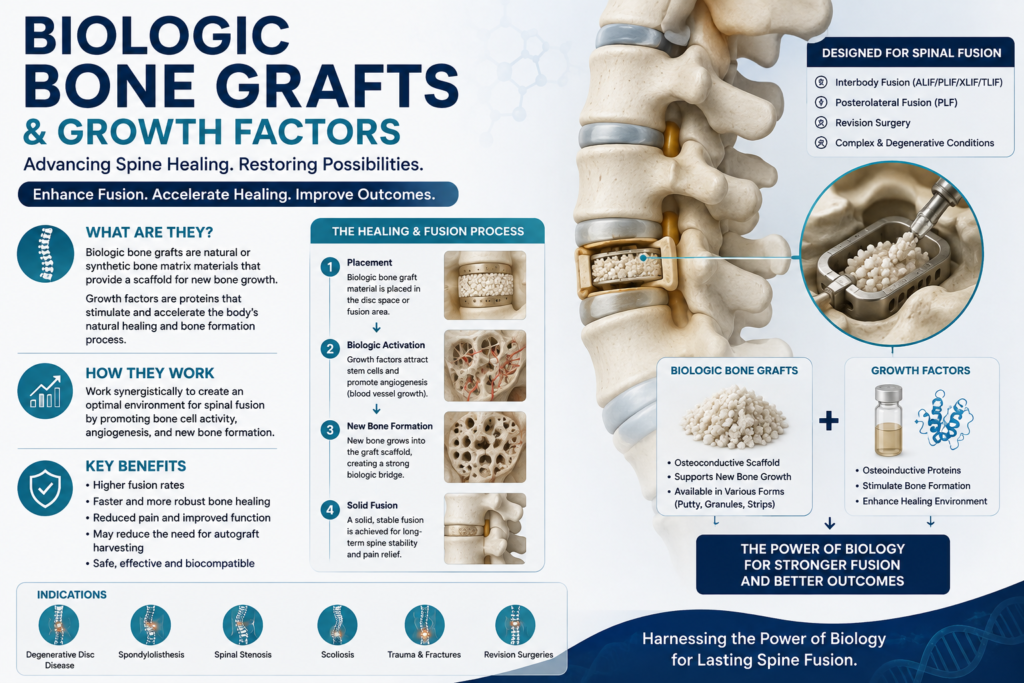
The advent of biologic bone grafts bridges these gaps by combining synthetic or natural scaffolds with bioactive molecules. These materials do not merely act as passive space-fillers; they actively signal surrounding cells to migrate, proliferate, and differentiate into bone-forming osteoblasts.
Osteoconduction: Providing a porous scaffold that allows existing bone cells to grow across the graft.
Osteoinduction: Recruiting undifferentiated stem cells and stimulating them to develop into bone-forming cells.
Osteogenesis: Direct bone formation via living cells contained within the graft material.
2. Categories of Biologic Bone Grafts
Modern biologic grafts are categorized based on their composition and source. Clinicians select these materials tailored to the specific biomechanical and biological demands of the defect site.
-
Demineralized Bone Matrix (DBM): Allograft bone treated to remove mineral content, exposing naturally occurring growth factors like bone morphogenetic proteins (BMPs).
-
Bioactive Glasses and Ceramics: Synthetic scaffolds designed with controlled porosity and degradation rates to optimize cellular infiltration.
-
Cell-Based Allografts: Advanced products containing viable mesenchymal stem cells (MSCs) suspended in a supportive matrix, delivering active regenerative components directly to the surgical site.
-
Composite Grafts: Combinations of ceramics, polymers, and biological agents engineered to mimic the exact mechanical strength and bioactivity of native bone.
3. The Power of Growth Factors
Growth factors are naturally occurring proteins that act as molecular messengers, regulating cellular events essential for tissue repair. In bone regeneration, specific proteins play a pivotal role in orchestrating the healing cascade.
Bone Morphogenetic Proteins (BMPs)
BMPs, particularly BMP-2 and BMP-7, are among the most potent osteoinductive growth factors known. Discovered through their ability to induce ectopic bone formation, recombinant human BMPs (rhBMPs) are now manufactured using biotechnology and applied clinically to promote fusion in spinal surgeries and critical-size bone defects, eliminating the need for a secondary harvest site.
Platelet-Derived Growth Factor (PDGF)
PDGF plays a critical role in blood vessel formation (angiogenesis) and cellular recruitment. In periodontal and maxillofacial surgeries, combination products featuring recombinant human PDGF with a beta-tricalcium phosphate matrix have revolutionized the regeneration of lost alveolar bone and periodontal attachment.
Vascular Endothelial Growth Factor (VEGF)
New bone cannot form without an adequate blood supply. VEGF stimulates angiogenesis, ensuring that newly forming bone tissue receives the vital oxygen, nutrients, and progenitor cells required for long-term survival and remodeling.
4. Clinical Applications and Future Directions
The integration of biologic grafts and growth factors touches numerous medical specialties:
Orthopedic Surgery: Treating complex fractures, non-unions, and large bone defects resulting from trauma or tumor resection.
Spine Surgery: Enhancing interbody fusion rates and reducing recovery times without harvesting autologous bone.
Dentistry and Maxillofacial Surgery: Rebuilding jawbone architecture prior to dental implant placement to ensure optimal structural support.
As biotechnology advances, the future will likely see customized, 3D-printed scaffolds seeded with patient-specific growth factors and stem cells, opening new frontiers in personalized regenerative medicine.
Key Takeaway: Biologic bone grafts and growth factors represent a paradigm shift in tissue engineering, moving modern medicine closer to true biological restoration rather than simple mechanical repair.