
Your spine is the structural foundation of your entire body. Beyond housing and protecting the spinal cord—the central communication highway of your nervous system—a healthy spine enables balance, flexibility, and painless movement.
To understand spine health, it helps to understand its natural curvature and main divisions:
Cervical Spine (Neck): Supports the head and allows wide rotational movement. Highly susceptible to modern “tech neck” strain.
Thoracic Spine (Mid-Back): Anchors the rib cage and offers stability to protect internal organs.
Lumbar Spine (Lower Back): Carries the bulk of body weight and absorbs high physical stress, making it the most common area for disc herniation and lower back pain.
Sacrum and Coccyx (Base): Connects the spine to the pelvis, transmitting upper body loads directly to the legs.
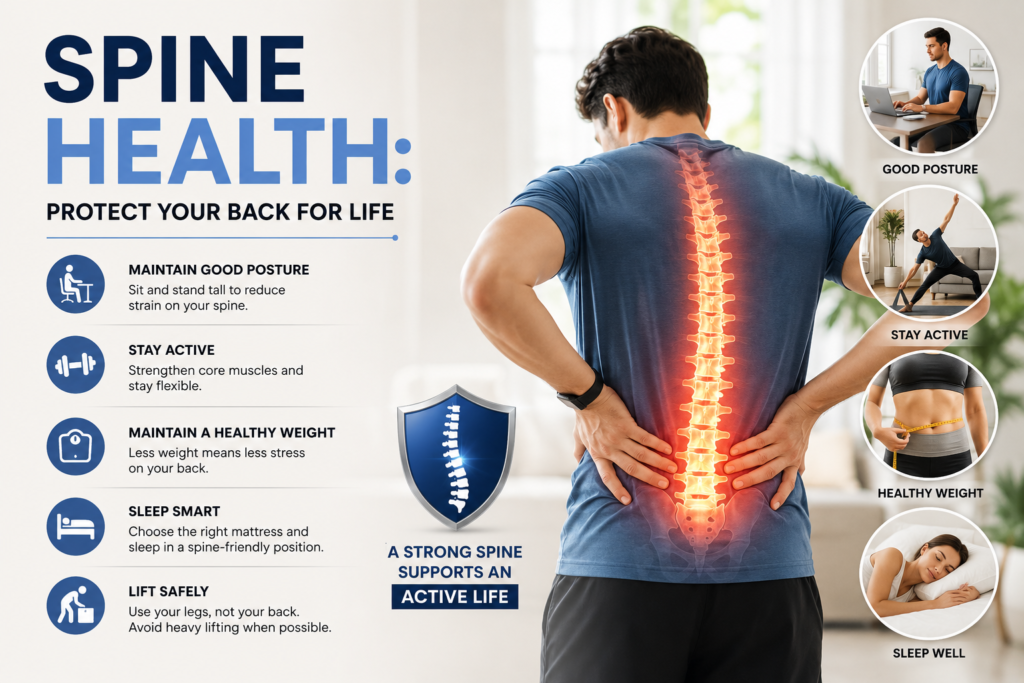
1. Master Ergonomics at Your Desk
Prolonged sitting compresses intervertebral discs. Align your setup to maintain the natural “S-curve” of your back:
Keep monitors at eye level to prevent forward neck posture.
Place feet flat on the floor with hips and knees at 90-degree angles.
Use lumbo-sacral support to prevent lower back slumping.
2. Strengthen Core and Supporting Muscles
Your spine relies on a muscular corset—including the abdominal wall, obliques, glutes, and spinal erectors—to stay aligned.
Core Stability: Planks, bird-dogs, and pelvic tilts build deep abdominal support.
Low-Impact Cardio: Swimming, walking, and cycling deliver oxygenated blood flow to spinal tissues without harsh compression.
3. Move and Stretch Daily
Intervertebral discs do not have a direct blood supply; they absorb nutrients through movement (“fluid exchange”). Taking short 2-minute movement breaks every 45 minutes preserves disc hydration and mobility.
To safeguard your back for life, focus on four fundamental habits:
Build Core Stability: Strong abdominal muscles, obliques, and glutes act as a natural brace for your lower back, taking pressure off your intervertebral discs.
Master Safe Lifting: Always bend at your knees and hips—not your waist. Keep heavy objects close to your chest and engage your core before lifting.
Practice Dynamic Ergonomics: Avoid remaining in static sitting positions for hours. Keep your monitor at eye level, sit with feet flat, and stand up every 30 minutes to move.
Optimize Sleep Posture: Side sleepers should place a pillow between their knees, while back sleepers benefit from a pillow under the knees to maintain a neutral lumbar curve.
Investing just a few minutes each day in basic core exercises and posture awareness will keep your spine resilient, flexible, and pain-free for decades to come.
Build Core Stability: Strong abdominal muscles, obliques, and glutes act as a natural brace for your lower back, taking pressure off your intervertebral discs.
Master Safe Lifting: Always bend at your knees and hips—not your waist. Keep heavy objects close to your chest and engage your core before lifting.
Practice Dynamic Ergonomics: Avoid remaining in static sitting positions for hours. Keep your monitor at eye level, sit with feet flat, and stand up every 30 minutes to move.
Optimize Sleep Posture: Side sleepers should place a pillow between their knees, while back sleepers benefit from a pillow under the knees to maintain a neutral lumbar curve.
Investing just a few minutes each day in basic core exercises and posture awareness will keep your spine resilient, flexible, and pain-free for decades to come.
Maintaining long-term spine health requires consistent daily habits rather than occasional quick fixes. The spine consists of 33 individual vertebrae cushioned by intervertebral discs, designed to support weight, absorb shock, and protect the central nervous system. Modern sedentary lifestyles and poor ergonomics subject this vital structure to continuous stress, leading to chronic back pain, spinal misalignments, and premature disc degeneration. Protecting your back for life depends on three core pillars: dynamic movement, core stability, and proper body mechanics. Regular low-impact cardiovascular activity keeps intervertebral discs hydrated, while core-strengthening exercises reinforce the muscular framework that stabilizes the lumbar spine. Incorporating ergonomic adjustments—such as keeping screens at eye level, taking frequent standing breaks, and lifting heavy objects using the legs rather than the lower back—prevents repetitive strain. Prioritizing posture and consistent spinal alignment today guards against mobility loss and protects long-term health.
While occasional muscular soreness resolves with rest and gentle movement, persistent or nerve-related symptoms require expert evaluation by a spine specialist or neurologist.
Red Flag Symptoms:
Continuous pain lasting longer than 4 to 6 weeks
Sharp, shooting pain traveling down the leg or arm (sciatica)
Numbness, tingling, or weakness in hands, feet, or legs
Pain that disrupts sleep or intensifies at rest